Spice Nest
Star Anise
Star Anise
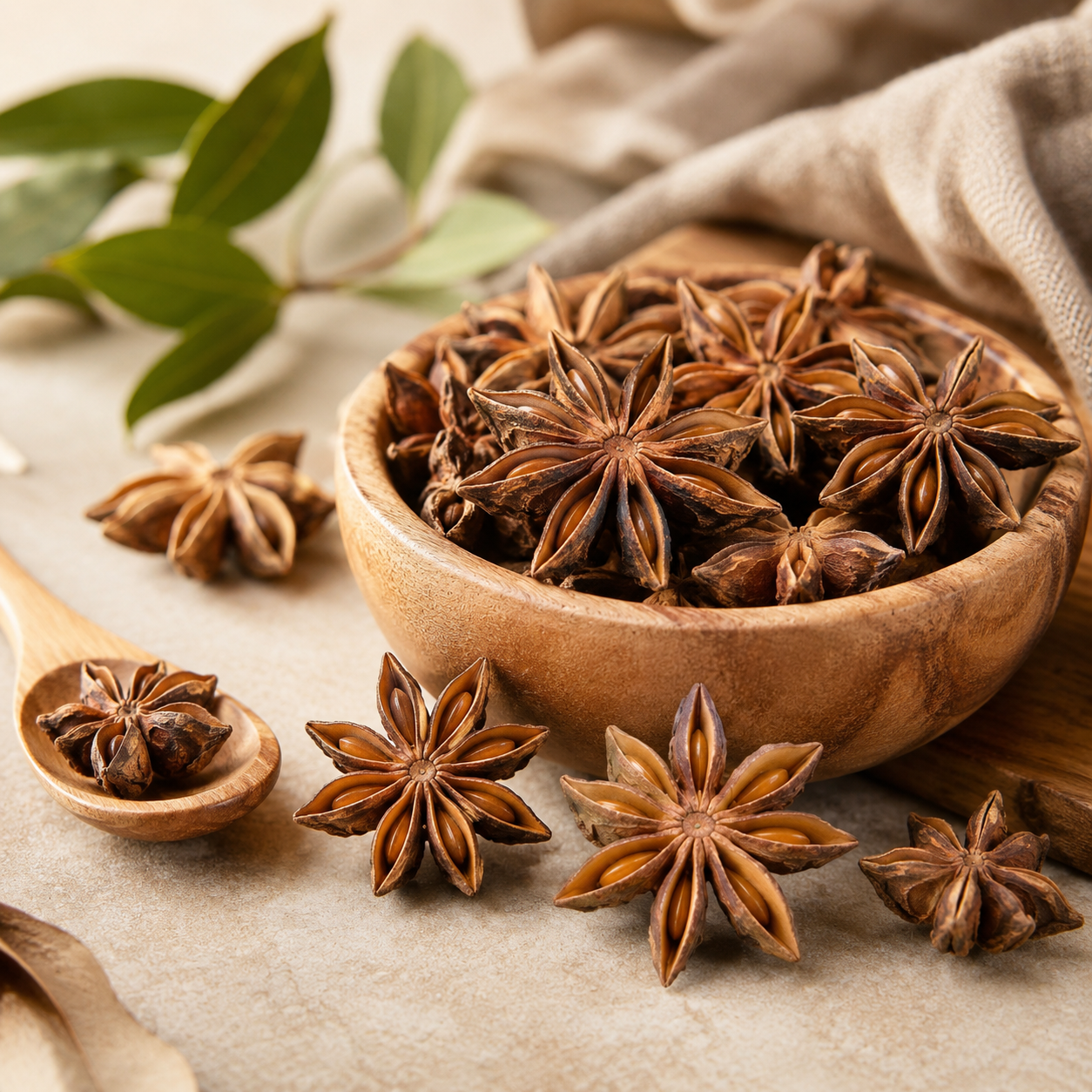
Spice Nest Premium Star Anise is a whole aromatic spice valued for its distinctive star shape, warm fragrance and intense sweet-spice flavour. These dried star anise pods are suitable for professional kitchens, spice brands, food manufacturers, restaurants, retailers and home cooking applications.
True culinary star anise comes from the dried fruit of Illicium verum. The Spices Board of India identifies it as a star-shaped dried fruit belonging to the Illiciaceae family. The fruit usually consists of several hard, boat-shaped carpels arranged in the familiar star pattern.
Whole star anise works especially well in recipes where slow infusion is needed. It can be simmered in broths, sauces, curries and beverages, toasted before use, or ground when a finer spice format is required.
Star anise is particularly associated with Chinese savoury cooking and Chinese five-spice blends. It is also widely used as an aromatic ingredient in Vietnamese pho broth.
Spice Nest operates from India as a spice manufacturer, supplier and exporter and supports bulk, wholesale and private-label spice requirements. For Star Anise, actual botanical origin should be confirmed according to the sourced lot and final product documentation rather than assuming that every batch is India-grown.
Specification
| Specification Details | Information |
|---|---|
| Product Name | Premium Whole Star Anise |
| Brand Name | Spice Nest |
| Product Type | Whole Aromatic Spice |
| Common Name | Star Anise / Chinese Star Anise / Badian |
| Botanical Name | Illicium verum |
| Family | Illiciaceae |
| Commercial Part | Dried Fruit |
| Form | Whole Star-Shaped Dried Fruit / Commonly Called Star Anise Pods |
| Appearance | Distinctive Star-Shaped Fruit with Multiple Carpels |
| Colour | Natural Reddish-Brown to Brown |
| Taste Profile | Warm, Sweet-Spiced, Strong and Anise-Like |
| Aroma | Intense, Sweet and Highly Aromatic |
| Processing | Cleaned, Sorted and Packed according to product specification |
| Packaging Type | Retail, Food-Service, Wholesale and Bulk Export Packaging |
| Net Weight | According to selected SKU or commercial order |
| Shelf Life | Refer to final product specification and best-before declaration |
| Storage Condition | Store tightly closed in a cool, dry place away from direct sunlight, moisture and excessive heat |
| Usage | Pho, Chinese Five-Spice, Curries, Broths, Marinades, Meat Dishes, Pickling, Baking and Spice Blends |
| Suitable For | Retailers, Wholesalers, Importers, Distributors, Restaurants, Hotels, Spice Brands and Food Manufacturers |
| Botanical Origin | To be confirmed according to sourced lot |
| Supplier / Export Location | India |
| Supply Type | Retail, Wholesale, Bulk, Export and Private Label |
| Export Market | International markets subject to destination-country requirements |
| Customization | Packaging and private-label requirements can be discussed for qualifying orders |
The Spices Board identifies southeastern China as the indigenous region of Illicium verum and states that commercial production is concentrated mainly in China and Vietnam, with small-scale production also found in Arunachal Pradesh, India.
Packaging & Customization
Spice Nest supports bulk Star Anise, wholesale spice requirements and export-oriented sourcing for businesses that need whole spices for retail, food service or manufacturing.
Commercial requirements can differ significantly by buyer. A retailer may require branded consumer packs, while an importer, spice blender or food manufacturer may prefer larger bulk packaging.
Spice Nest also operates a private-label program for spice products. Its current private-label information states that businesses can discuss customized spice products, branding and packaging according to specific market requirements.
This can support businesses looking for:
Star Anise bulk supply, whole Star Anise wholesale, private-label Star Anise, Star Anise for food manufacturing, Star Anise for restaurants, and export-oriented spice sourcing.
Actual pack sizes, botanical origin, quality parameters, labeling, order quantity and documentation should be finalized according to the commercial order.
Health Benefits
Star Anise should primarily be positioned as an aromatic culinary spice, not as a medicine or dietary treatment.
Scientific research has investigated Illicium verum and its naturally occurring compounds, but research into a plant or isolated compound does not mean that a normal culinary Star Anise product can legally or scientifically be advertised as treating disease.
For this reason, Spice Nest should avoid aggressive statements such as:
“cures digestive problems,” “boosts immunity,” “causes weight loss,” “treats flu,” or “works as medicine.”
The safer and more useful consumer message is that Star Anise adds strong aroma, flavour and culinary versatility to foods, broths, beverages and spice blends.
There is also an important safety distinction between food-grade Chinese Star Anise, Illicium verum, and Japanese Star Anise, Illicium anisatum. FDA information describes Japanese Star Anise as toxic and unsuitable for food use.
Key Benefits of Whole Star Anise
Strong Aromatic Flavour
Whole Star Anise has an intense aroma, so a relatively small quantity can noticeably influence a dish.
Its distinctive flavour works particularly well in recipes that allow spices to slowly infuse into liquid.
Ideal Star Anise for Pho
One of the strongest search interests around this spice is Star Anise in pho.
Star Anise is commonly incorporated into Vietnamese pho broth with other aromatic spices. Pho recipes frequently combine it with ingredients such as cinnamon, cloves and other warm spices to develop the broth's characteristic aromatic profile.
Important in Chinese Cooking
The Spices Board identifies Star Anise as one of the signature flavours used in Chinese savoury cooking.
It can be used in braised foods, marinades, meat preparations, vegetables and aromatic sauces.
Suitable for Chinese Five-Spice Blends
Star Anise is an established ingredient in Chinese five-spice formulations.
This makes whole Star Anise useful for spice manufacturers and seasoning brands developing their own five-spice blends.
Suitable for Curries and Savoury Cooking
Star Anise can add aromatic depth to curries, slow-cooked sauces and other savoury preparations.
Because its flavour is concentrated, it is usually used as one component of a broader spice profile rather than dominating the entire recipe.
Useful for Broths and Soups
Whole Star Anise is well suited to broth-based recipes because the spice can slowly infuse flavour during simmering.
The whole pieces can then be removed before serving when desired.
Excellent for Marinades
Star Anise can be included in marinades for meat and other savoury preparations.
The Spices Board specifically identifies Star Anise as a spice used in meat flavouring and marinades.
Suitable for Pickling
Star Anise can add warm aromatic flavour to selected pickling formulations.
The Spices Board also lists pickling among its established culinary applications.
Useful in Bakery and Confectionery
Although strongly associated with savoury Asian cooking, Star Anise also has applications in baked products and confectionery.
Its essential aromatic character is used across bakery products and other flavouring applications.
Whole-Spice Flexibility
Buyers can use Star Anise whole for infusion or grind it according to their formulation requirements.
This gives whole Star Anise an advantage for businesses that need flexibility across multiple recipes.
Distinctive Visual Appearance
The natural star shape gives the product a recognizable premium-spice appearance.
It can therefore work well in clear retail spice packs as well as professional culinary applications.
Suitable for Spice Blending
Whole Star Anise can be processed for spice blends, seasoning mixes and commercial formulations.
Businesses can select whole or ground formats depending on how the finished product will be used.
Bulk Supply for Commercial Buyers
Spice Nest supports bulk and wholesale spice enquiries as part of its broader manufacturing and export business.
Importers, distributors, retailers and food businesses can discuss quantity, sourcing, packaging and specification requirements.
Private Label Support
Businesses building their own spice brand can discuss customized packaging and private-label solutions through Spice Nest's existing private-label program.
Frequently Asked Questions
1. What is Star Anise?
Star Anise is a spice made from the dried star-shaped fruit of Illicium verum.It is valued for its intense aroma and is used across Chinese, Southeast Asian and other international cuisines.
2. What are Star Anise pods?
“Star Anise pods” is a common consumer term for the dried star-shaped fruits sold as a spice.Botanically, the commercial part is the dried fruit rather than a true botanical pod.
3. What does Star Anise taste like?
Star Anise has a powerful sweet-spice, anise-like aroma and flavour.Spice Nest's existing Star Anise Powder product also describes the spice as warm and licorice-scented.
4. What does Star Anise smell like?
Star Anise has an intense sweet, spicy and anise-like fragrance.The aroma becomes especially noticeable when the whole spice is warmed, toasted or simmered.
5. What is Star Anise used for?
Star Anise is used in broths, curries, marinades, meat preparations, Chinese five-spice, confectionery, pickling and other flavouring applications.
6. How do you use Star Anise?
Whole Star Anise can be added during cooking and allowed to infuse into a broth, curry, sauce or marinade.The whole spice can then be removed before serving.
7. How do you use whole Star Anise?
Use whole Star Anise when you want flavour to infuse gradually.It works particularly well in soups, broths, braises, curries and marinades.
8. Can Star Anise be ground?
Yes, Whole Star Anise can be ground for recipes or commercial formulations that require a more evenly distributed spice.Spice Nest also currently offers Star Anise Powder as a separate product.
9. What is Star Anise in pho?
Star Anise is one of the aromatic spices commonly used while preparing Vietnamese pho broth.It contributes a warm and distinctive aromatic note to the broth.
10. How much Star Anise should I use in pho?
The correct amount depends on the broth quantity and recipe.Because Star Anise has a strong flavour, it is generally better to follow the specific pho recipe rather than adding large amounts by estimation.
11. Is Star Anise used in Chinese five-spice?
Yes, Star Anise is an established component of Chinese five-spice blends.
12. Can Star Anise be used in curries?
Yes, The Spices Board lists curry flavouring among Star Anise's culinary uses.
13. Can Star Anise be used in meat dishes?
Yes, It can be used to flavour meats, braised dishes and marinades.
14. Can Star Anise be used for pickling?
Yes, Pickling is one of the culinary applications identified by the Spices Board.
15. Can Star Anise be used in baking?
Yes, Star Anise flavour is also used in bakery and confectionery applications.
16. Is Star Anise the same as anise?
No, Star Anise and anise are different plants.Star Anise is Illicium verum, while anise or aniseed is Pimpinella anisum. The two have similarities in aroma but are botanically different spices.
17. Is Star Anise the same as anise seed?
No, Anise seed comes from a different plant, Pimpinella anisum. Star Anise comes from the dried fruit of Illicium verum.
18. What is the difference between Star Anise and anise seed?
The main difference is botanical origin and physical form. Star Anise is a star-shaped dried fruit, while aniseed is the small fruit commonly marketed as a seed from Pimpinella anisum.
19. What can I substitute for Star Anise?
A substitute depends on the recipe. Aniseed or a suitable Chinese five-spice blend may provide some related aromatic notes, but the finished flavour will not be identical.
20. Is Star Anise the same as cloves?
No, Star Anise and cloves are different spices with different flavour profiles.They are sometimes used together in aromatic recipes.
21. Is Star Anise the same as fennel?
No,Fennel and Star Anise come from different plants, although both can contribute sweet, anise-like aromatic notes.
22. Where does Star Anise come from?
The Spices Board identifies southeastern China as the indigenous region of Star Anise.Commercial production is concentrated mainly in China and Vietnam, with limited production also occurring in Arunachal Pradesh, India.
23. Is Star Anise grown in India?
Yes, but on a relatively limited scale.The Spices Board reports small-scale production in Arunachal Pradesh.
24. Is all Star Anise from India?
No,China and Vietnam are major commercial producing regions.For Spice Nest orders, actual origin should therefore be confirmed according to the specific sourced lot.
25. What is Chinese Star Anise?
Chinese Star Anise generally refers to food-grade Illicium verum.It is the culinary Star Anise used as a spice.
26. What is Japanese Star Anise?
Japanese Star Anise refers to Illicium anisatum, a related species that is not suitable for food.FDA information identifies Japanese Star Anise as toxic and notes the importance of distinguishing it from edible Chinese Star Anise.
27. Is Star Anise poisonous?
Food-grade Illicium verum is the culinary species.However, closely related Japanese Star Anise is toxic, which is why correct botanical identity and responsible sourcing matter.
28. Can Star Anise be used in tea?
Star Anise appears in beverage-related searches and traditional preparations, but buyers should use only correctly identified food-grade Illicium verum.FDA previously reported illnesses involving Star Anise teas and raised concerns about possible contamination with toxic Japanese Star Anise.For this reason, medicinal or infant-tea claims should not be made for the product.
29. What are the benefits of Star Anise?
For a food product, the clearest benefits are aroma, flavour and culinary versatility.Research has investigated Illicium verum and its chemical constituents, but this does not establish that ordinary culinary Star Anise treats or prevents medical conditions.
30. Is Star Anise healthy?
Star Anise is primarily a culinary spice.It can be incorporated into normal cooking, but it should not be promoted as a replacement for medical treatment or as a proven cure for health conditions.
31. How should whole Star Anise be stored?
Keep whole Star Anise tightly closed in a cool, dry location away from direct sunlight, moisture and excessive heat.Always follow the storage instructions printed on the final product pack.
32. Does Star Anise go bad?
Like other dried spices, Star Anise gradually loses aroma and flavour over time.Follow the best-before date and storage directions stated on the actual Spice Nest pack.
33. Where can I buy Star Anise?
Consumers can purchase Star Anise through spice retailers and appropriate online sales channels.Commercial buyers can contact Spice Nest to discuss whole Star Anise sourcing, bulk quantities and export requirements.
34. Where can I buy whole Star Anise?
Whole Star Anise is available through specialty spice channels and commercial spice suppliers.Businesses requiring larger quantities can discuss sourcing and packaging requirements with Spice Nest.
35. Can I buy Star Anise in bulk?
Yes,Spice Nest supports bulk and wholesale spice enquiries as part of its spice supply and export operations.
36. Does Spice Nest supply whole Star Anise wholesale?
Whole Star Anise can be discussed for wholesale and commercial sourcing according to quantity, quality specification, sourcing availability and packaging requirements.
37. Is Spice Nest a Star Anise supplier in India?
Spice Nest operates from Gujarat, India, as a spice supplier, manufacturer and exporter and supports B2B spice enquiries.For Star Anise, the agricultural origin of the material should be confirmed separately for each sourced lot.
38. Can Star Anise be exported from India?
Yes,A spice trading or packing company in India can supply Star Anise internationally subject to sourcing, food-safety requirements, labeling, documentation and destination-country rules. Spice Nest currently describes its business as supporting international spice exports.
39. Is private-label Star Anise available?
Private-label requirements can be discussed through Spice Nest.The company's existing private-label program covers customizable spice products, packaging and branding requirements.
40. Can food manufacturers buy Star Anise in bulk?
Yes,Whole Star Anise can be suitable for spice processors, seasoning manufacturers, sauce producers and other food businesses that require aromatic spice ingredients.The required grade, origin, size and packaging should be confirmed according to the manufacturing application.
41. Can restaurants buy Star Anise wholesale?
Yes,Restaurants, hotels, caterers and food-service suppliers that regularly prepare pho, broths, curries, marinades or other aromatic dishes can discuss commercial quantities.
42. Can spice brands source whole Star Anise from Spice Nest?
Yes,Spice brands can discuss bulk sourcing as well as packaging and private-label requirements through Spice Nest's B2B program.
43. Is organic Star Anise available?
An organic claim should only appear when the specific supplied product is supported by the required organic certification and documentation.Do not advertise this Star Anise as organic until the exact lot and applicable certification have been verified.
44. What determines Star Anise price?
Star Anise pricing can vary according to botanical origin, crop quality, appearance, whole-versus-broken content, order volume, packaging and current sourcing conditions.Commercial buyers should therefore request a current quotation rather than rely on a fixed historical price.
45. Why choose Spice Nest for bulk Star Anise sourcing?
Spice Nest combines its India-based spice business with bulk sourcing, export support and private-label capabilities.For commercial buyers, this allows discussions around whole Star Anise supply, bulk quantities, packaging, branding and international requirements within one B2B sourcing process.