Spice Nest
Psyllium Husk
Psyllium Husk
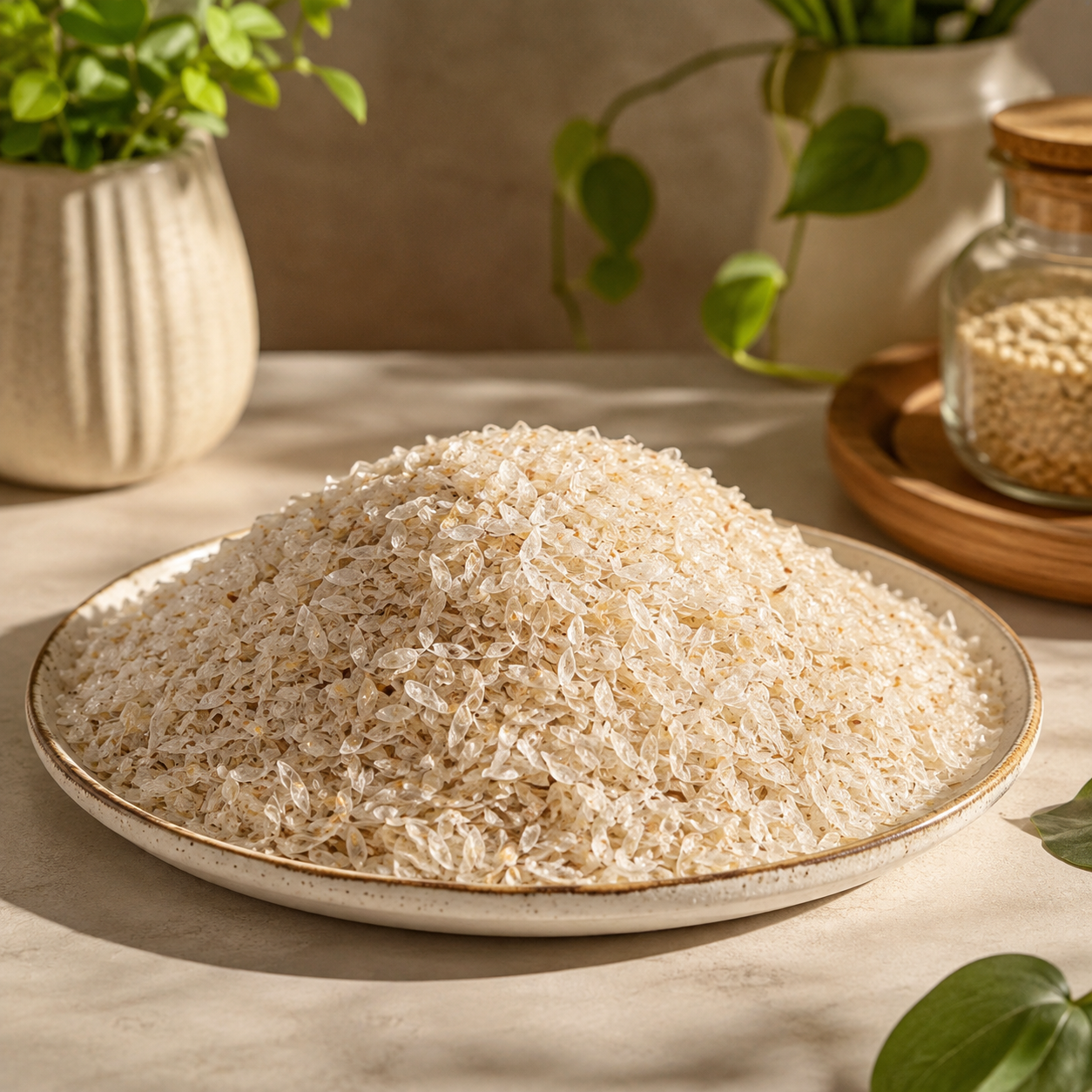
Spice Nest Premium Psyllium Husk is a carefully processed natural fiber ingredient obtained from the seed coat of Plantago ovata, a plant commonly associated with psyllium, isabgol, and ispaghula. Psyllium husk is valued for its high water-absorbing, gel-forming properties and versatile use in dietary fiber products, beverages, food formulations, and baking applications.
Carefully cleaned, graded, and hygienically processed, Spice Nest Psyllium Husk is prepared to maintain consistent quality, natural texture, and functional performance. With bulk supply, export-ready packaging, and private label options, it is suitable for supermarkets, health-food retailers, food manufacturers, nutraceutical businesses, wholesalers, importers, and distributors across global markets.
Specification
| Specification | Details |
|---|---|
| Product Name | Premium Psyllium Husk |
| Brand Name | Spice Nest |
| Botanical Name | Plantago ovata |
| Common Name | Psyllium Husk / Isabgol / Ispaghula |
| Product Type | Natural Plant-Based Fiber Ingredient |
| Product Form | Psyllium Husk |
| Ingredients | Psyllium Husk |
| Processing Method | Cleaned, Graded & Hygienically Processed |
| Grade / Purity | As per selected grade and product specification / COA |
| Packaging Type | Retail Packaging / Bulk Export Packaging Available |
| Net Weight | As per packaging option |
| Shelf Life | As per packaging details |
| Storage Condition | Store in a cool, dry place away from direct sunlight and moisture |
| Taste Profile | Mild, Neutral & Natural |
| Usage | Fiber Blends, Beverages, Food Processing, Baking & Recipe Formulations |
| Suitable For | Retailers, Food Manufacturers, Nutraceutical Businesses, Wholesalers, Importers & Distributors |
| Country of Origin | India |
| Export Market | USA, UK, UAE, Saudi Arabia, Qatar & Worldwide |
Packaging & Customization
Bulk packaging and private label solutions are available for international buyers, wholesalers, importers, retailers, food manufacturers, nutraceutical businesses, and distributors based on their specific requirements.
Packaging size, branding, labelling, and export packing can be customized according to order quantity, destination market, and buyer requirements.
Health Benefits
Psyllium husk is a gel-forming dietary fiber obtained from the outer seed coat of Plantago ovata. When mixed with water, it absorbs liquid and develops a viscous gel, a functional property linked to many of its food and dietary applications.
Clinical research on psyllium fiber has examined its role in digestive regularity, cholesterol management, glycemic control, and weight-management programs. Benefits can vary according to product formulation, serving amount, diet, and individual health conditions.
Key Benefits of Psyllium Husk
Supports Digestive Regularity
Psyllium is a bulk-forming fiber that absorbs water and increases the water content and bulk of stool. Randomized-trial evidence and systematic reviews have found psyllium useful in improving stool frequency and consistency in adults with constipation.
FDA's OTC laxative monograph also recognizes Plantago ovata husks and other psyllium ingredients as bulk-forming laxative active ingredients when products are formulated and labelled according to the applicable OTC requirements.
Supports Heart-Healthy Dietary Goals
Research has found that psyllium supplementation can reduce LDL and total cholesterol in appropriate dietary settings. A 2025 systematic review and meta-analysis covering 41 randomized controlled trials reported significant reductions in LDL and total cholesterol following psyllium supplementation.
U.S. food-label regulations also permit a specific heart-health claim for qualifying foods that provide soluble fiber from psyllium seed husk and meet defined compositional and nutritional requirements. The regulation references 7 g or more per day of soluble fiber from psyllium seed husk in the context of diets low in saturated fat and cholesterol.
May Support Healthy Glycemic Control
Psyllium's gel-forming fiber can influence the way nutrients are absorbed. A systematic review and meta-analysis of randomized controlled trials reported improvements in fasting blood glucose, HbA1c, and insulin-resistance measures following psyllium supplementation, although results vary by population, dose, and duration.
May Support Weight-Management Efforts
Psyllium's viscous, gel-forming properties may help increase satiety when incorporated into an appropriate diet. A meta-analysis of randomized trials in overweight and obese adults reported modest reductions in body weight, BMI, and waist circumference under the studied conditions.
Psyllium should be viewed as a fiber ingredient that can complement a balanced diet and lifestyle, not as a standalone weight-loss treatment.
Useful in Baking & Food Formulations
Psyllium has strong water-binding, thickening, and texturizing properties. Food-science research describes its use as a hydrocolloid and functional ingredient in bakery products, including gluten-free formulations where it can contribute structure and moisture retention.
Natural Plant-Based Fiber Ingredient
Psyllium husk comes from the seed coat of Plantago ovata. The plant's native range extends through parts of North Africa and Southwest Asia to India, and official Indian medicinal-plant resources identify Plantago ovata husk as Isabgol.
Frequently Asked Questions
1. What is psyllium husk?
Psyllium husk is the fiber-rich outer seed coat of Plantago ovata. When mixed with water, it absorbs liquid and forms a viscous, gel-like material known for its functional use as dietary fiber and as a food ingredient.
Spice Nest Premium Psyllium Husk is prepared for retail, food-processing, wholesale, bulk, and export requirements.
2. Is psyllium husk the same as isabgol?
Yes, psyllium husk is commonly known as isabgol in India. Indian government medicinal-plant resources identify Plantago ovata as Isabgol and list the husk as its utilized plant part.
The terms psyllium, isabgol, and ispaghula may therefore appear in product searches and ingredient descriptions, although buyers should always check whether a particular product refers to whole seed, husk, or husk powder.
3. What is the difference between psyllium husk and psyllium husk powder?
Psyllium husk and psyllium husk powder come from the same seed coat but differ mainly in particle size and processing.
Regular psyllium husk retains larger flakes or husk particles, while psyllium husk powder is more finely milled. The finer powder can hydrate and thicken differently, so the two forms may not always work in exactly the same quantity in recipes or formulations. Psyllium's functionality is strongly influenced by hydration and rheological behaviour.
4. What are the main benefits of psyllium husk?
The most researched benefits of psyllium fiber relate to digestive regularity, LDL cholesterol reduction, glycemic control, and its usefulness as a viscous dietary fiber. Research also investigates psyllium as part of weight-management diets and functional food formulations.
Individual results depend on the amount consumed, overall diet, product formulation, and health status.
5. Is psyllium husk good for constipation and digestive regularity?
Psyllium has evidence supporting its use for constipation and bowel regularity. It absorbs water, increases stool bulk and water content, and can improve stool frequency and consistency.
When a psyllium product is specifically marketed as an OTC laxative in the United States, it must meet the applicable FDA formulation, directions, and labelling requirements.
6. Can psyllium husk help lower cholesterol?
Research indicates that psyllium fiber can contribute to reductions in LDL and total cholesterol when used appropriately as part of the diet.
In the United States, an authorized health claim exists for qualifying foods providing soluble fiber from psyllium seed husk, subject to specific nutritional, purity, soluble-fiber, and labelling conditions.
7. Does psyllium husk help with weight loss?
Psyllium is not a weight-loss drug, but its gel-forming fiber may support satiety and can complement a calorie-conscious diet.
A meta-analysis involving overweight and obese participants found modest reductions in weight, BMI, and waist circumference under the conditions studied.
For sustainable weight management, psyllium should be considered one component of an appropriate diet, physical activity, and overall lifestyle plan.
8. How should psyllium husk be taken?
Psyllium should be mixed with sufficient liquid and consumed according to the directions on the specific product label.
This is particularly important because dry psyllium expands rapidly when exposed to liquid. FDA directions for applicable dry bulk-forming laxative products require mixing or taking the dose with at least 8 ounces-one full glass-of water or another fluid.
Never consume dry psyllium without adequate fluid.
9. How much psyllium husk should I take daily?
There is no single universal serving that applies to every psyllium food, supplement, or formulation.
The appropriate amount depends on the product type, intended use, formulation, age, and individual needs. Consumers should follow the directions printed on their specific package or seek professional guidance when using psyllium for a health-related purpose.
10. When is the best time to take psyllium husk?
There is no universally established "best time" that applies to everyone. The appropriate timing depends on why the product is being used and the directions provided by its manufacturer.
For routine dietary use, following the product's recommended serving instructions consistently and consuming adequate fluid is more important than choosing one specific time of day.
11. How do you mix psyllium husk with water?
Add the recommended amount of psyllium to sufficient water or another suitable liquid, stir promptly, and consume according to the product directions before the mixture becomes excessively thick.
Adequate hydration is important because psyllium expands and forms a gel. FDA guidance for applicable dry bulk-forming laxative products specifically warns that taking such products without enough fluid can cause choking or blockage of the throat or esophagus.
12. Can psyllium husk be used for baking and gluten-free recipes?
Yes. Psyllium is widely studied as a functional ingredient in baking, particularly in gluten-free formulations.
Its water-binding and gel-forming properties can help improve dough or batter structure, viscosity, moisture retention, and texture. Research also describes psyllium as a potential gluten substitute or structural aid in certain gluten-free bakery applications.
However, use of psyllium in a recipe does not automatically make the final product certified gluten-free; all ingredients and cross-contact controls must also meet the relevant requirements.
13. What are the possible side effects and precautions of psyllium husk?
Increasing fiber intake can cause temporary digestive effects such as bloating or changes in bowel habits in some people. More importantly, dry psyllium needs adequate liquid because it swells significantly after hydration.
FDA labelling requirements for applicable dry bulk-forming laxative products warn against use by people with difficulty swallowing and advise immediate medical attention if chest pain, vomiting, difficulty swallowing, or difficulty breathing occurs after use.
Consumers with medical conditions or specific dietary requirements should follow the product label and appropriate professional advice.
14. How should psyllium husk be stored?
Psyllium husk should be stored in a cool, dry place away from direct sunlight, heat, and moisture.
Keep the packaging properly sealed after opening. Because psyllium readily interacts with water and develops a gel, protecting the product from unwanted humidity helps maintain its handling quality.
Always follow the storage instructions printed on the final Spice Nest packaging.
15. Where can I buy premium psyllium husk in bulk from India?
Spice Nest offers Premium Psyllium Husk from India for enquiries from importers, wholesalers, food manufacturers, nutraceutical businesses, retailers, supermarkets, and international distributors.
Bulk and export packaging requirements can be discussed for buyers in the USA, UK, UAE, Saudi Arabia, Qatar, and other international markets. Private label, customized packaging, and buyer-specific packing solutions are also available based on order quantity and commercial requirements.